
 01
Enlarge
NEW
Dolibarr v18-v24
KSIDol module with 1 year of updates
1 year of updates included
Store and till management software | KSIDol
Dolibarr retail module: scan-first TakePOS till, sealed NF525 closings, barcodes, stock counts, transfers, replenishment, loyalty, promotions.
Installation, configuration and technical support are available separately.
Module gallery
Screenshots and module previews
01
Enlarge
 02
Enlarge
 03
Enlarge
 04
Enlarge
 05
Enlarge
 06
Enlarge
 07
Enlarge
 08
Enlarge
 09
Enlarge
Functional details
Store and till management software - Dolibarr module for shops and multi-store retailers
KSIRetail turns Dolibarr into store management software: points of sale, registers, barcodes, handheld stock counts, transfers, scanned supplier receipts, replenishment, returns, loyalty, gift cards, promotions and web orders are all driven from a single interface. The module opens no parallel circuit: products, stock, invoices, payments, credit notes and purchase orders remain the native objects of your ERP. Till functions require the native Point of sale (TakePOS) module, and scanned receipts the Receptions module.
Your stores, your registers, your sales staff
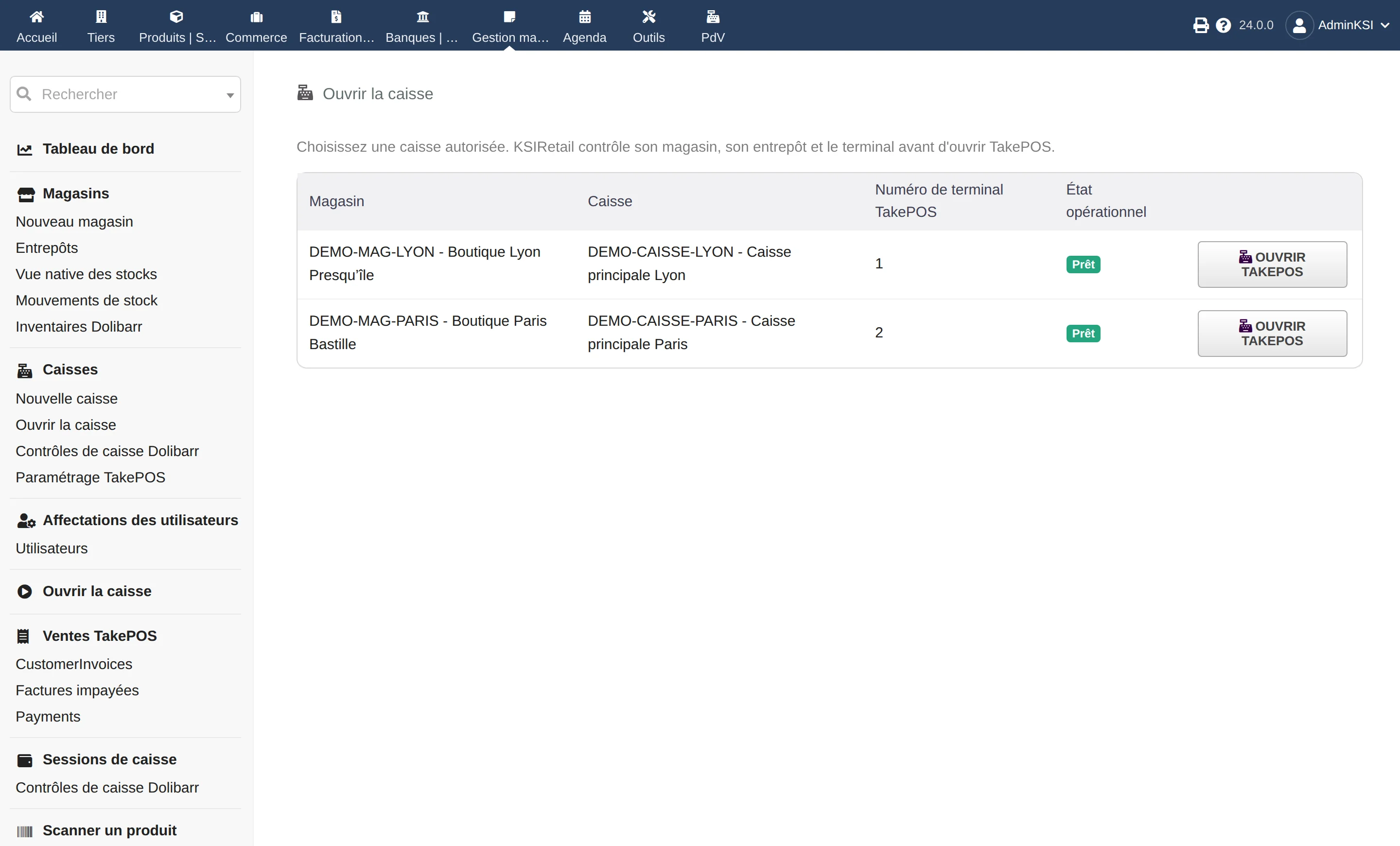
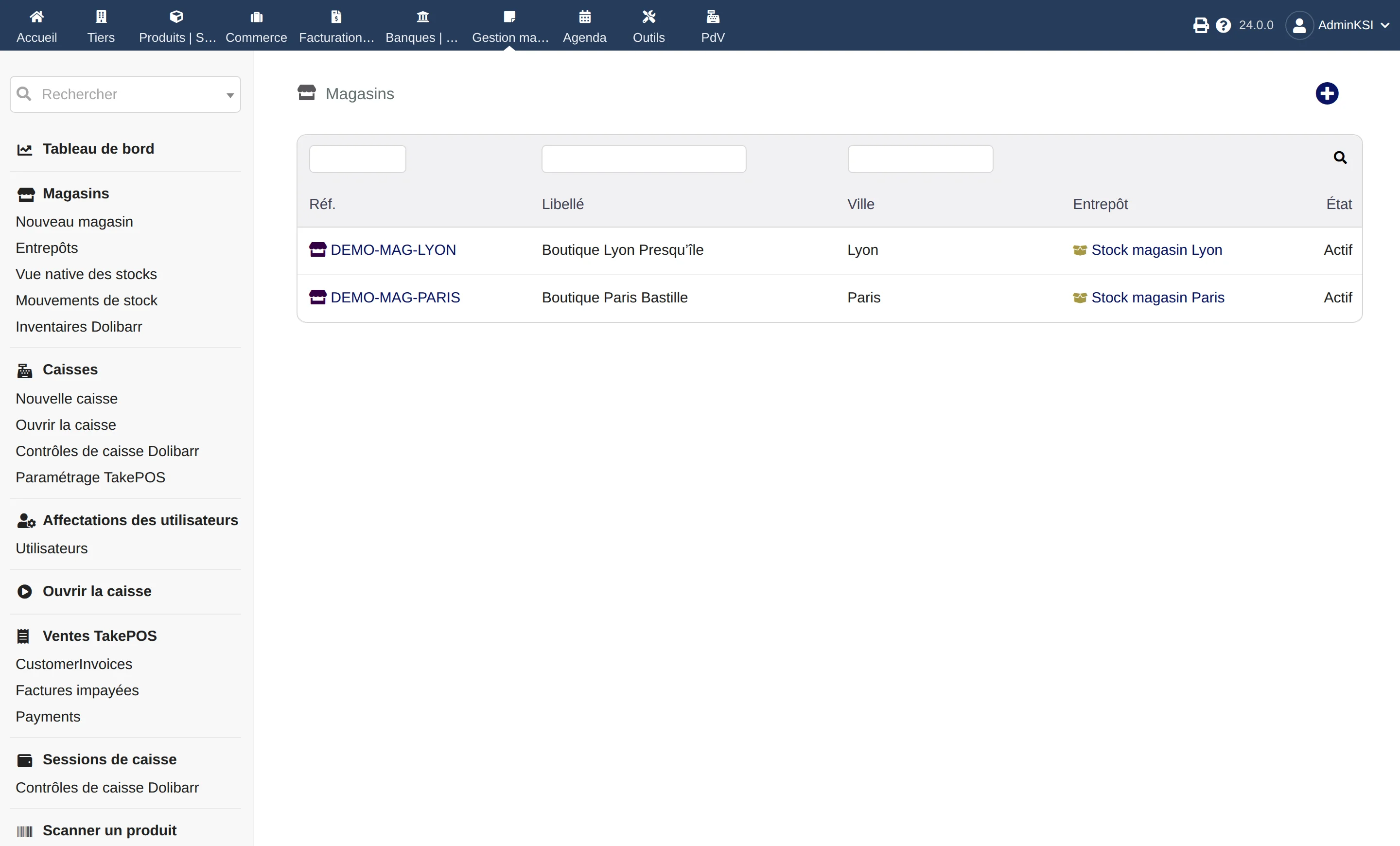
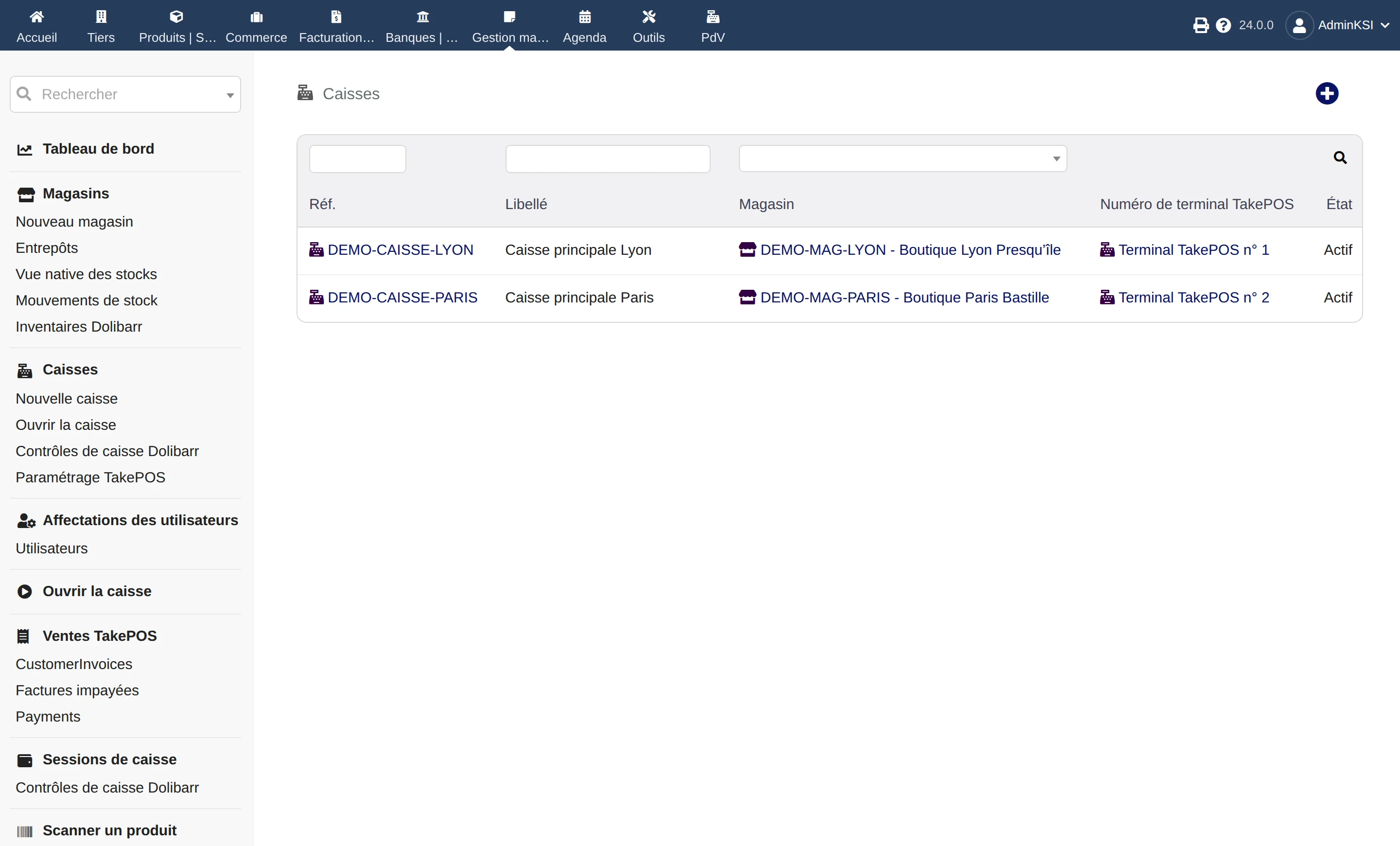
You bind each store to a Dolibarr warehouse: the shop floor stock is then the native stock, not a copy. Registers carry their TakePOS terminal number, and each member of staff is assigned to one or more stores, with a role and a default store. Item by item, you set the minimum stock, the desired stock and the preferred supplier for each store.
The Dolibarr till, finally workable in a shop
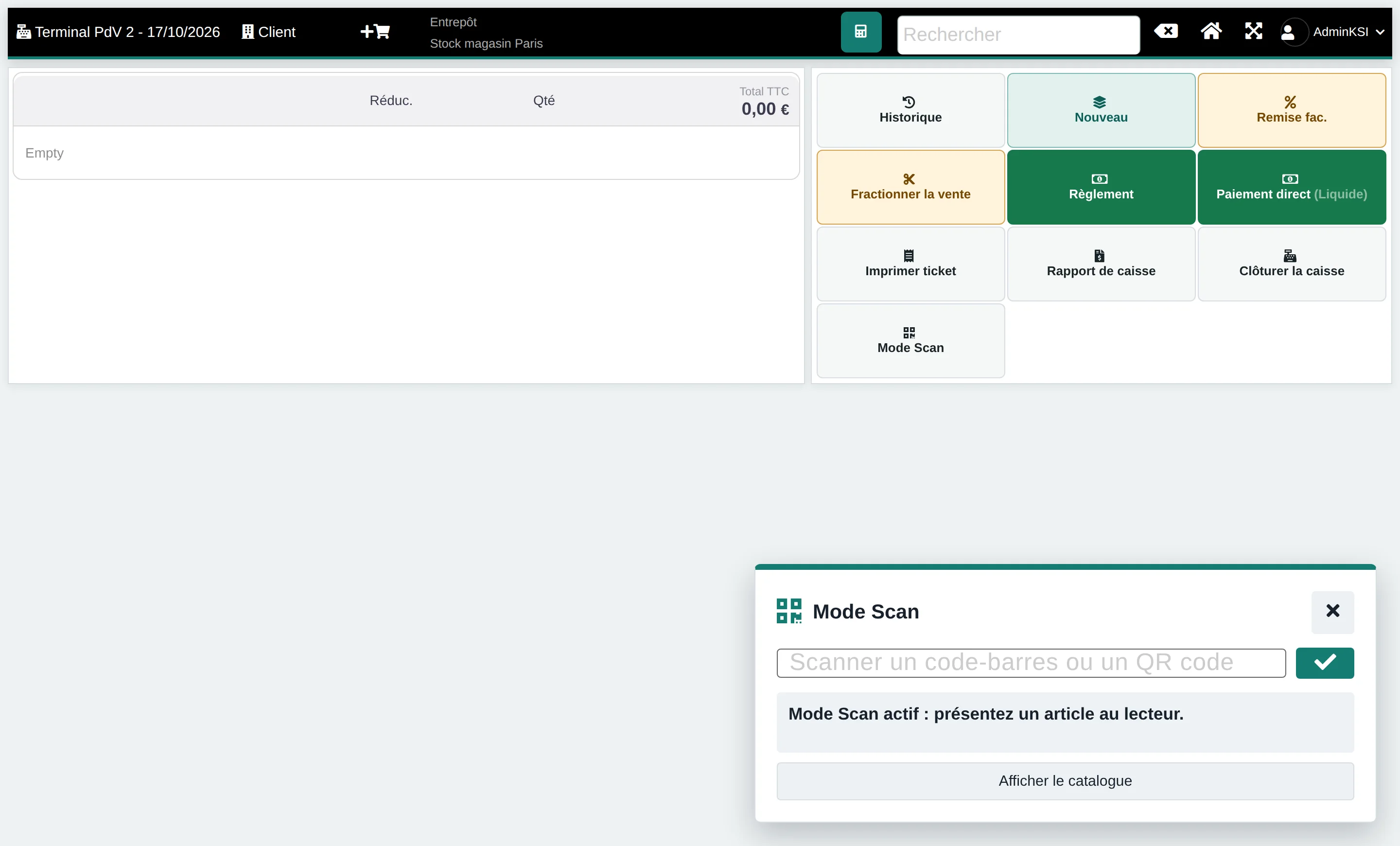
KSIRetail does not replace TakePOS: it makes it usable behind a counter. The till only opens if the user is assigned to the store, the terminal exists and the warehouse is consistent - a launch screen shows the state of every register before you enter it. At the till, scan-first mode puts the cursor in the scanner field and moves the thumbnails behind a "Catalogue" button. Appearance, density and keypad are set in the configuration, without touching the code, and adding to the basket always goes through the native function: price, VAT, invoice, payment and stock stay native.
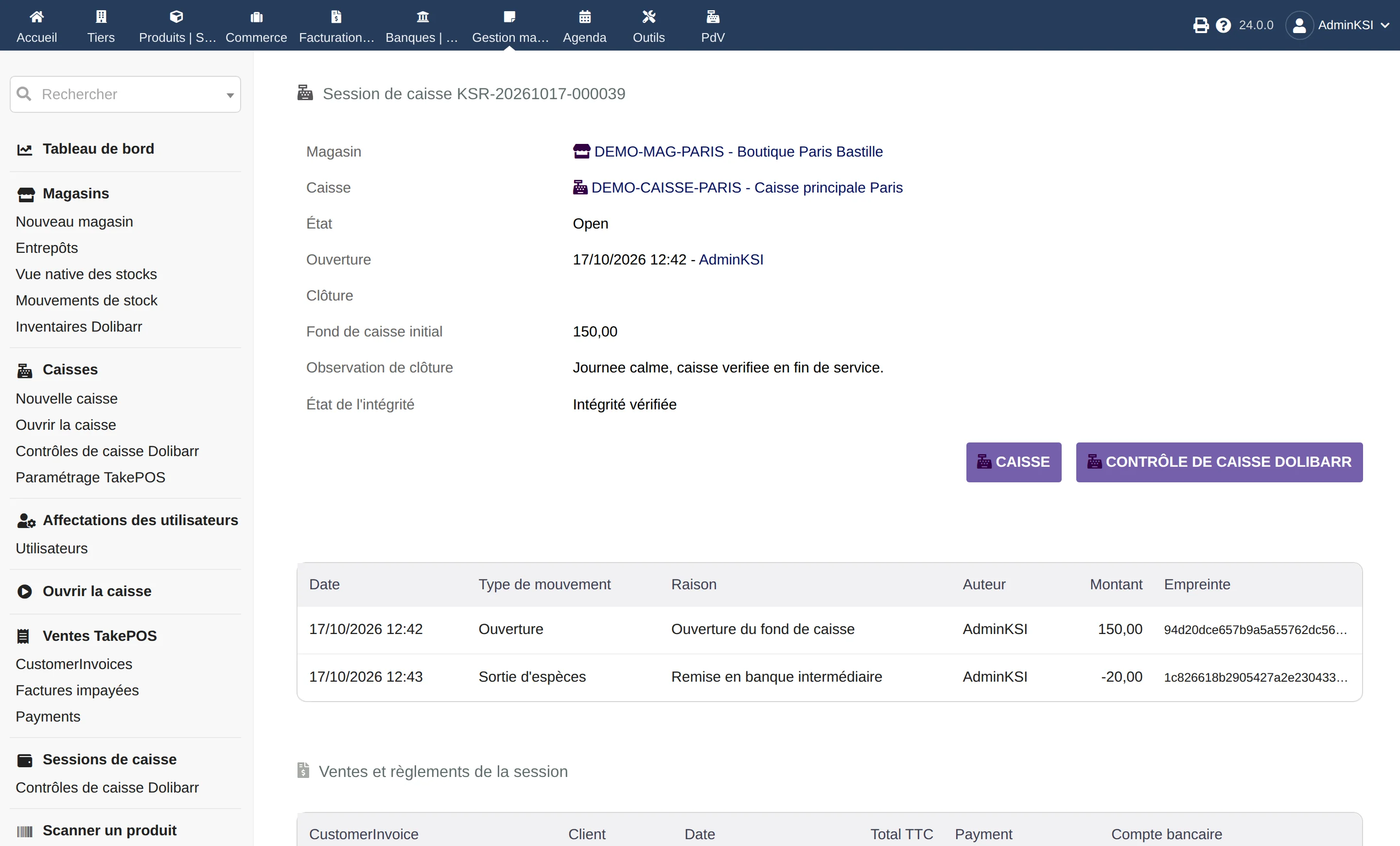
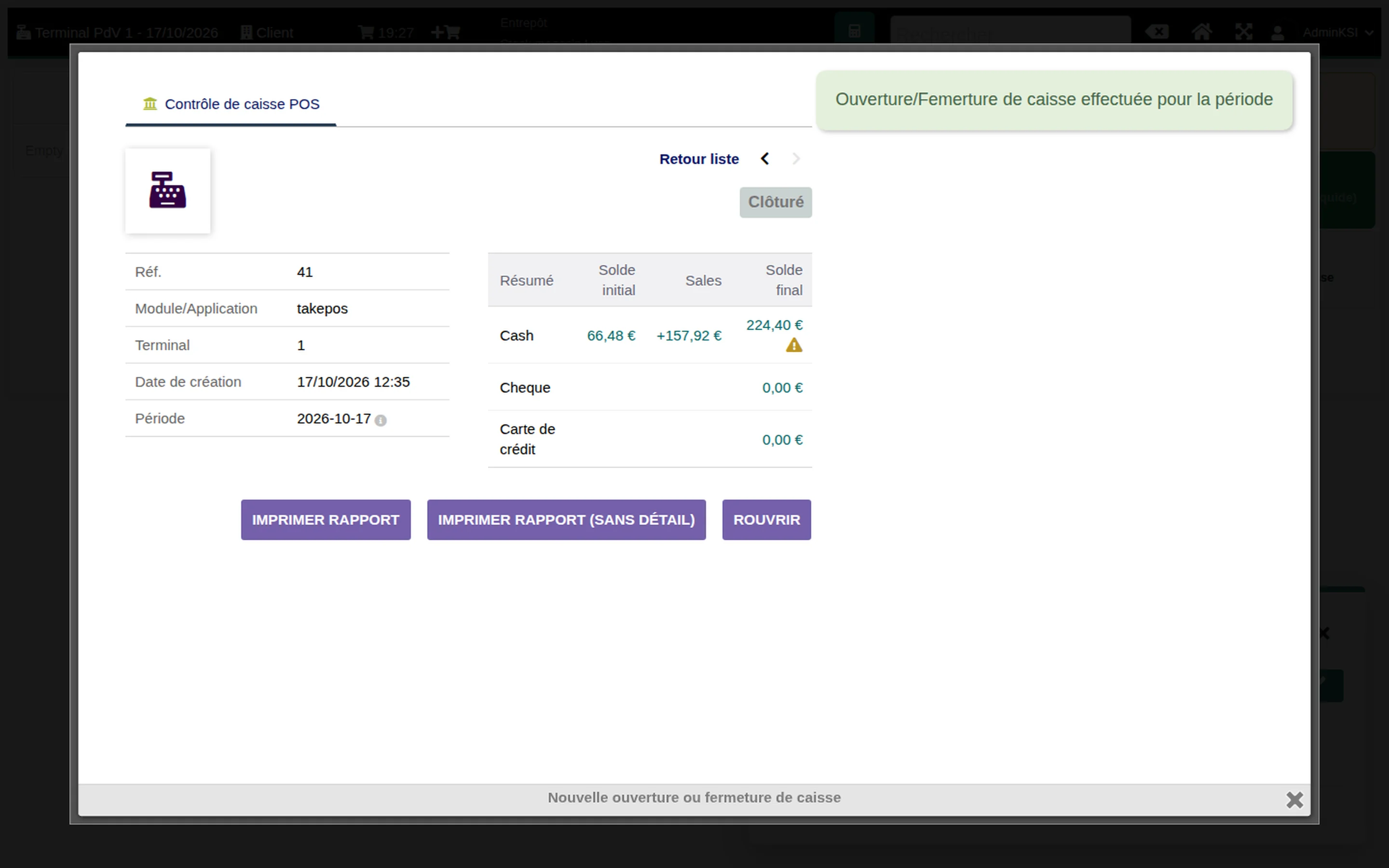
Cash sessions, discrepancies and evidence
A session opens per register with its float; cash in, cash out and corrections carry a reason and a timestamp. Closing compares, for cash, card and cheque, the expected amount, the declared amount and the discrepancy. Every event carries the fingerprint of the previous one, the record recomputes the integrity state of the chain, and closing produces a sealed, numbered archive that can be exported as JSON for an audit. With the native unalterable logging module enabled, deleting an already-logged closing is refused — and this chain meets the data-security, immutability and retention requirements that apply to till records under France's anti-VAT-fraud rules (NF525). KSIRetail is a module, not a certification: it equips your installation for technical compliance, provided your Dolibarr is correctly configured and, where required, duly attested — a step of its own, specific to your installation.
Barcodes, labels and catalogue import
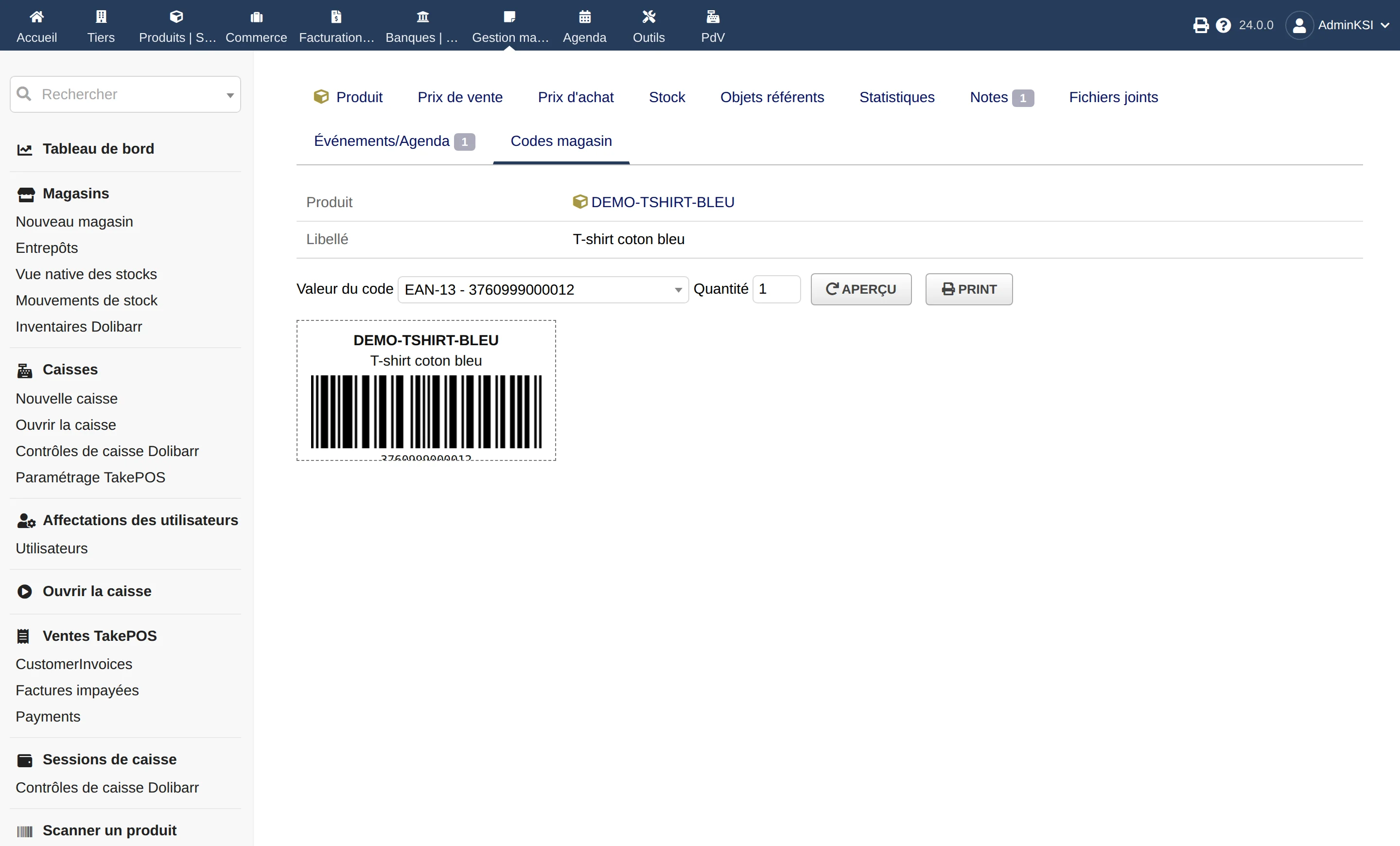
An item can carry several codes - internal, EAN-8, EAN-13, UPC-A, ISBN-13, Code 128, QR, supplier -, with the check digit validated for the numeric codes (EAN, UPC, ISBN); the web scanner resolves the native Dolibarr barcode just as well. A label sheet prints straight from the browser, from 1 to 100 copies of one code at a time. The catalogue CSV import works on eleven documented columns, with a strictly validated header and a preview: it creates and updates native products, prices and codes - not stock, not categories, not photos.
Stock counts, transfers and receipts, all with a scanner
The stock count is still the Dolibarr one, driven store by store and counted by scanning, as an increment or as an absolute figure, with batches and serial numbers supported; nothing moves in stock before the final recording, and double counting has two users count without either seeing the other's figure. An inter-store transfer goes through a transit warehouse: the receiving store checks, gives a reason for the discrepancy, and the remainder stays visible in transit stock until its own movement. A supplier receipt is scanned from a shipped purchase order, over several passes - stock only moves when the Dolibarr receipt is validated, and that receipt records the store and the warehouse.
Replenishment and returns: the machine does the maths, you make the call
A run per store computes coverage item by item: current stock, transit, quantities already ordered through the module, average daily till sales, lead time and pack size taken from the native supplier prices. Every line can be amended or dropped, with a mandatory reason, then native purchase orders are created grouped by supplier and left as drafts: nobody orders in your name. A return starts from a validated invoice in a Dolibarr that decrements stock on invoicing (native setting required, like TakePOS for the till), checks the quantity still returnable, creates and validates a native Dolibarr credit note without touching the original invoice, and puts the item back on the shelf or into quarantine, with the reason written down.
Loyalty, gift cards and promotions
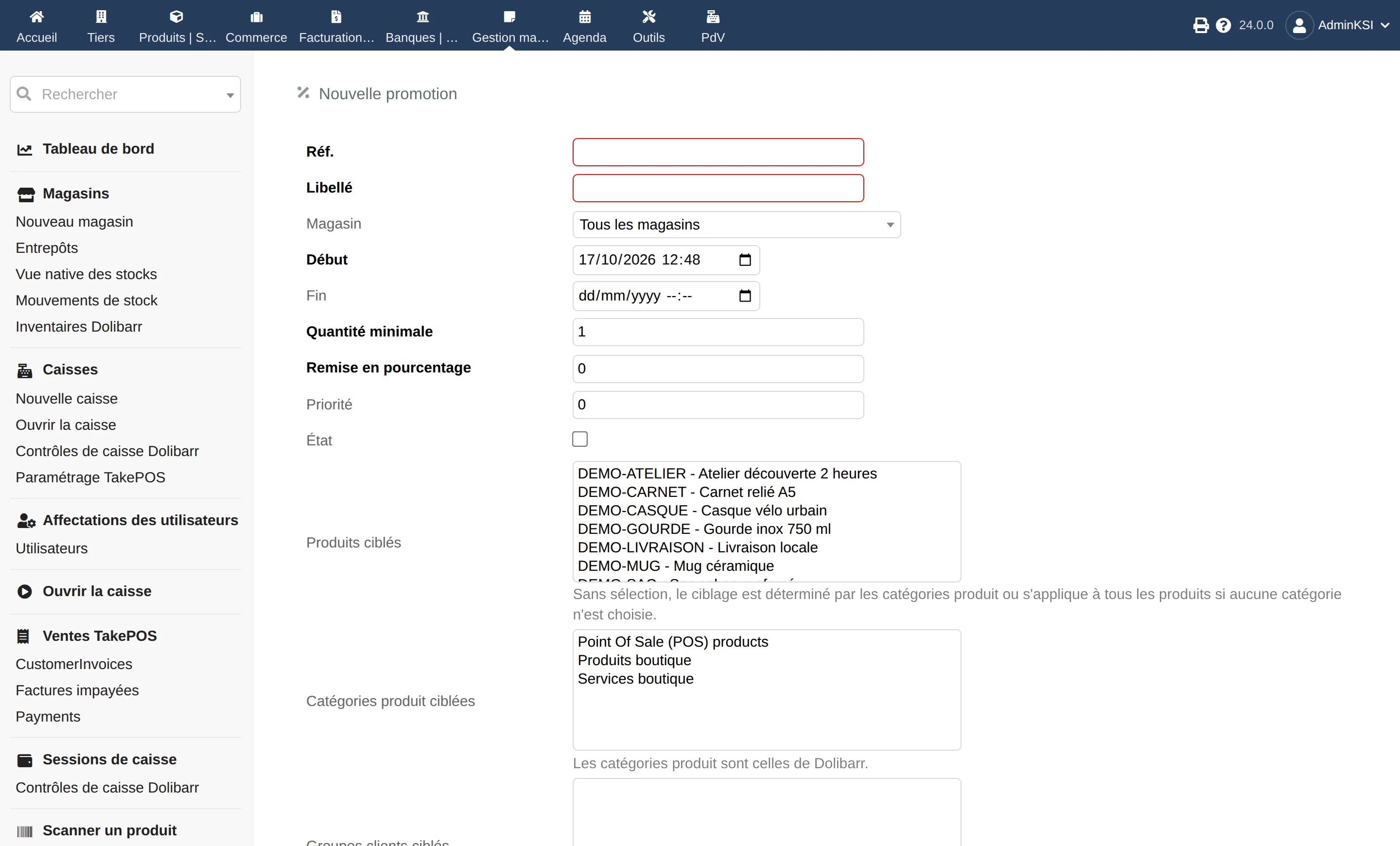
Loyalty accounts sit on the native customer records: you credit points from the customer record, at a configurable rate, on a paid invoice, every balance is the verifiable sum of its log, and conversion produces a native Dolibarr fixed discount, not a parallel means of payment; points carry a validity date and expired points can no longer be spent. Gift cards have their balance and their movement log, the code being shown once and then kept as a fingerprint. Promotions are dated percentages with a minimum quantity and a priority, targeted by store, by product, by product category or by customer category; they are applied in one click to a draft till invoice, the best eligible rule wins, a larger manual discount is preserved, and every application is logged.
Web orders inside your Dolibarr orders
Three versioned REST routes take an order, return its status and publish a store's stock. Orders land as native Dolibarr orders, as drafts, for collection or delivery, with no duplicate even if the shop sends the same message twice; conflicts go to quarantine with their synchronisation journal. Publishable stock is the native stock less your safety threshold and the quantities already reserved. Each connector has its own internal account, and this part requires the native REST API module.
A module built for the counter
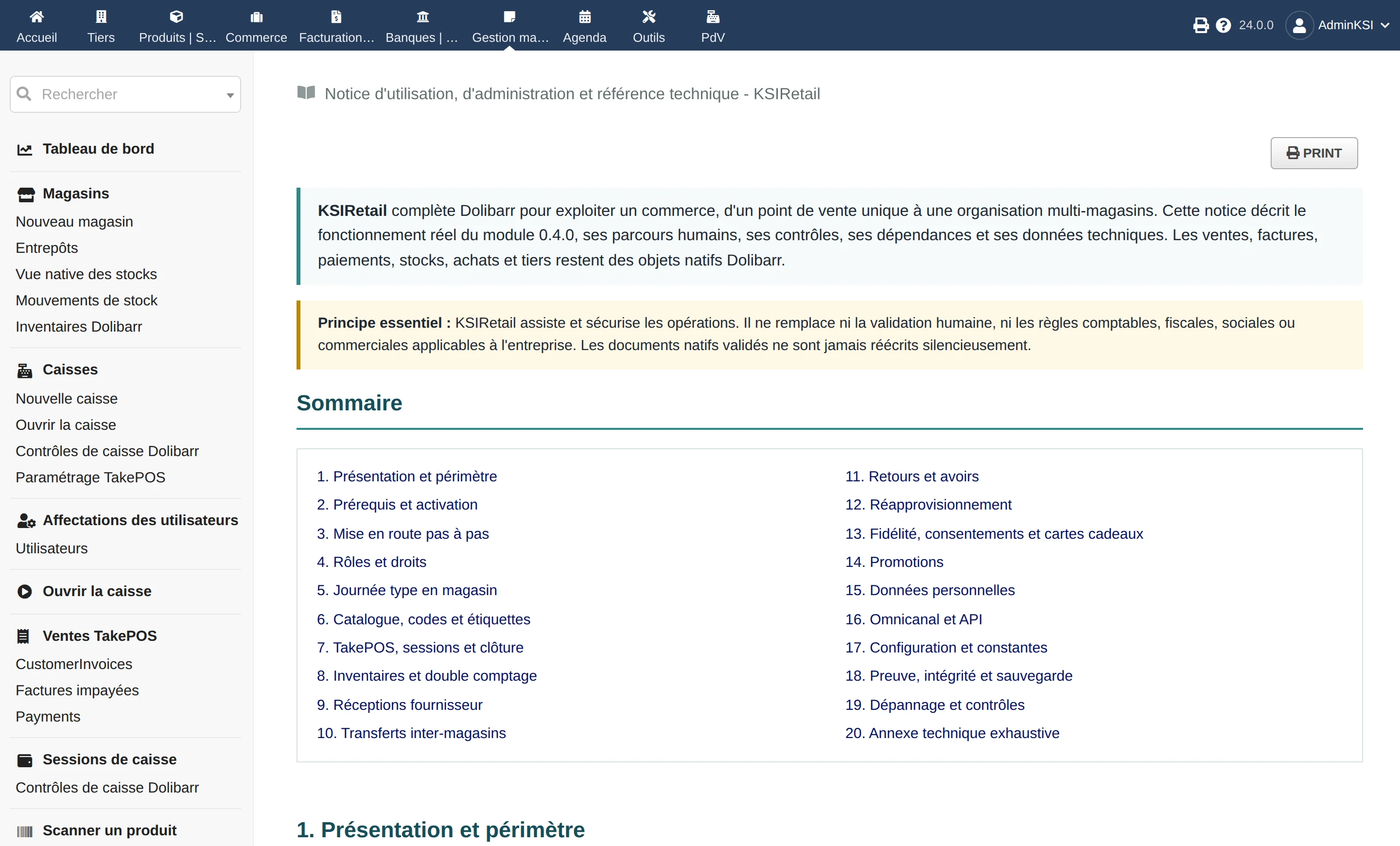
KSIRetail ships in five languages (French, English, German, Spanish, Italian) with no text hard-coded in the source, and is compatible with Dolibarr v18 to v24. It adds thirteen tabs onto native records and breaks access down into seventeen distinct permissions, including the export of till evidence. A complete guide, in French, prints from the menu, and all your data stays with you, in your own Dolibarr.
Need a standalone module, a SaaS instance or a complete solution?
KSIDol can sell the module, host it inside a Dolibarr instance and extend everything with custom development, support, document customization and email or SMS workflows.
